
Product Design
From idea to product: The SaaS product design process used by successful startups


Stay ahead with ideas that drive growth.
Get practical insights on product design, development, AI, and digital strategy delivered straight to your inbox.
No spam. Just thoughtful insights and actionable ideas.

Lumeburg is an AI-first, human-centric design and development agency helping startups, SaaS companies, and scale-ups build exceptional digital products, websites, and user experiences.
Share on :

From idea to product: The SaaS product design process used by successful startups
Building a successful SaaS product takes more than a great idea. Many startups fail not because the market doesn’t exist, but because they launch products that are difficult to use, solve the wrong problems, or fail to create a compelling user experience.
The most successful SaaS companies don’t start with polished interfaces or complex features. They begin with understanding users, validating assumptions, and designing experiences that solve real problems.
That’s where a structured SaaS product design process becomes essential.
In this guide, we’ll break down the complete product design workflow used by successful startups from idea validation to launch and show how great product design helps reduce risk, improve adoption, and accelerate growth.
What is SaaS product design?
SaaS product design is the process of creating digital products that solve user problems while delivering business value.
It combines:
User research
Product strategy
UX design
UI design
Prototyping
Testing
Development collaboration
The goal isn’t simply to create attractive interfaces. The goal is to design experiences that help users achieve outcomes efficiently and enjoyably.
Effective product design balances:
User needs
Business goals
Technical feasibility
When these three elements align, products become easier to adopt, retain users longer, and generate stronger revenue.
Why product design matters for SaaS startups
Many founders focus heavily on development while underestimating design.
However, product design directly impacts:
User Adoption
Users decide within minutes whether your product is worth learning.
Poor navigation, confusing workflows, or cluttered interfaces can drive users away before they experience the value your product provides.
Customer Retention
Retention is often the most important SaaS metric.
A well-designed experience helps users build habits, discover value faster, and remain engaged over time.
Development Efficiency
Design helps teams validate ideas before investing months in engineering.
By identifying usability issues early, startups avoid costly rework later.
Competitive Advantage
Features can be copied.
User experience is much harder to replicate.
Many successful SaaS products win because they provide a smoother, more intuitive experience than their competitors.
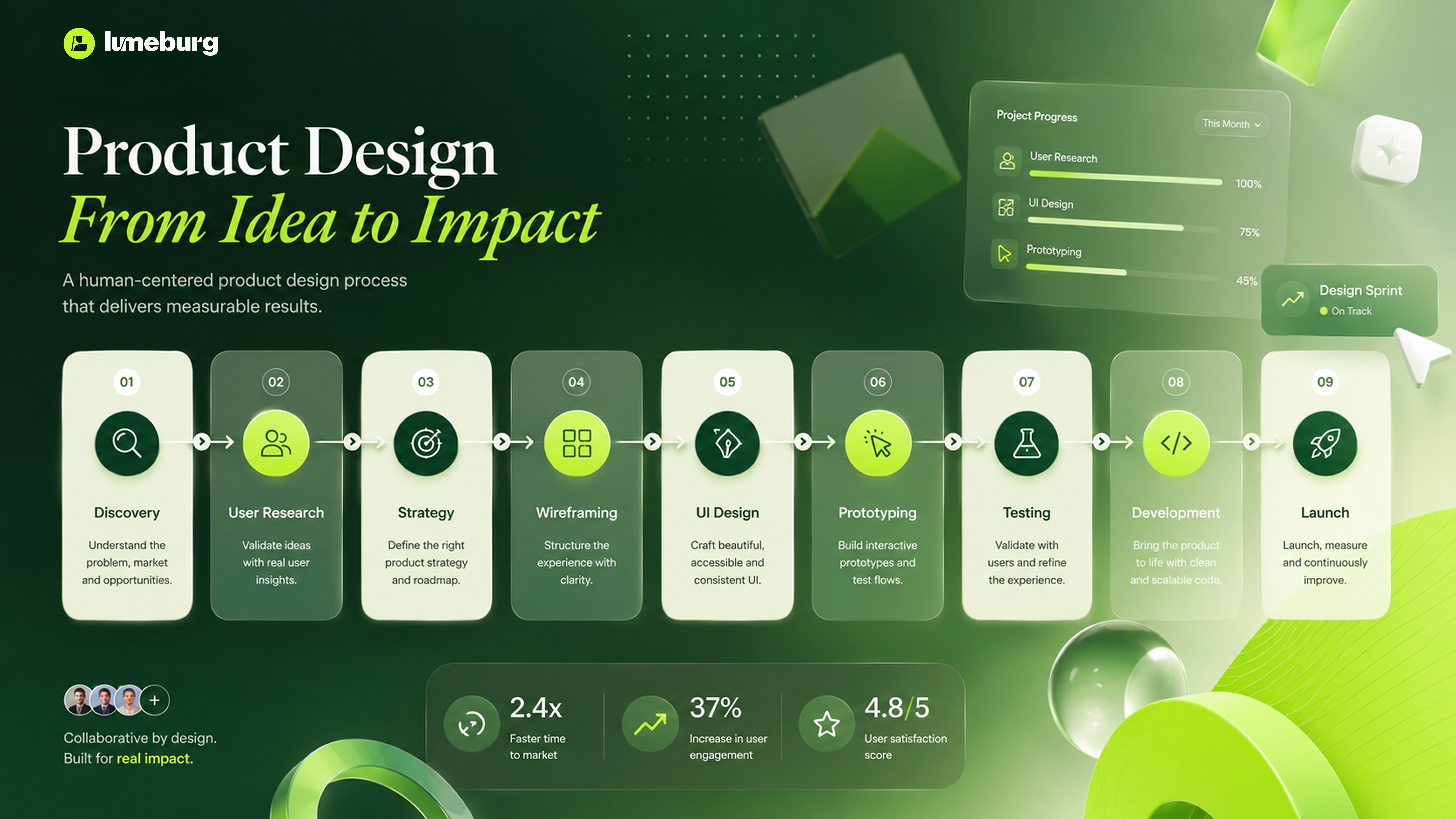
Stage 1: Discovery and product strategy
Every successful product starts with understanding the problem.
Before designing screens or features, teams must answer critical questions:
Who are the users?
What problems are they facing?
How are they solving those problems today?
Why would they switch to your product?
During the discovery phase, teams gather insights through:
Stakeholder Interviews
Conversations with founders, product managers, sales teams, and customer success teams help uncover business objectives and market opportunities.
Competitive Analysis
Studying competitors reveals:
Industry standards
Feature expectations
UX patterns
Market gaps
The goal isn’t copying competitors but identifying opportunities to create a better experience.
Market Research
Understanding market trends helps teams prioritize features that align with real customer demand.
By the end of discovery, startups should have a clear understanding of both user needs and business goals.
Stage 2: User research
Assumptions are dangerous.
User research replaces guesses with evidence.
Successful SaaS teams invest heavily in understanding user behavior before building solutions.
User Interviews
Direct conversations reveal:
Pain points
Motivations
Workflows
Decision-making processes
These insights often uncover opportunities that analytics alone cannot reveal.
Surveys
Surveys help validate findings across a larger audience and identify patterns among different user groups.
Behavioral Analysis
Researching how users interact with existing solutions provides valuable context for future design decisions.
The outcome of this phase is a clear understanding of who the users are and what they need.
Assumptions are dangerous.
User research replaces guesses with evidence.
Successful SaaS teams invest heavily in understanding user behavior before building solutions.
User Interviews
Direct conversations reveal:
Pain points
Motivations
Workflows
Decision-making processes
These insights often uncover opportunities that analytics alone cannot reveal.
Surveys
Surveys help validate findings across a larger audience and identify patterns among different user groups.
Behavioral Analysis
Researching how users interact with existing solutions provides valuable context for future design decisions.
The outcome of this phase is a clear understanding of who the users are and what they need.
Stage 3: Creating user personas
User personas help teams design for real people rather than abstract audiences.
A strong persona typically includes:
Role
Goals
Challenges
Behaviors
Motivations
Technology preferences
For example:
Startup Founder
Goals:
Scale efficiently
Save time
Improve team productivity
Challenges:
Limited resources
Tight deadlines
Rapid growth
Understanding personas helps teams prioritize features and design decisions that create meaningful value.
Stage 4: User flows and information architecture
Before designing interfaces, teams map how users move through the product.
User flows visualize:
Entry points
Actions
Decisions
Outcomes
This process identifies friction before development begins.
Information architecture organizes:
Navigation
Content hierarchy
Feature structure
Strong information architecture helps users find what they need quickly and confidently.
Poor architecture often leads to confusion, frustration, and churn.
Stage 5: Wireframing
Wireframes are low-fidelity representations of product screens.
At this stage, teams focus on:
Layout
Structure
User journeys
Feature prioritization
Not visual design.
Wireframing allows teams to:
Explore ideas rapidly
Validate workflows
Gather feedback
Reduce development risk
Because changes are inexpensive during wireframing, this phase encourages experimentation.
Stage 6: UI design
Once workflows are validated, teams move into visual design.
UI design transforms wireframes into polished product experiences.
This includes:
Visual Hierarchy
Guiding user attention toward important actions and information.
Typography
Creating readability and consistency throughout the product.
Color Systems
Establishing visual cues, accessibility, and brand identity.
Components and Design Systems
Reusable design elements improve consistency and accelerate development.
A strong UI creates trust, credibility, and a premium user experience.
Stage 7: Interactive prototyping
Static designs don’t reveal the full user experience.
Interactive prototypes simulate how the product will behave.
Teams use prototypes to:
Test workflows
Demonstrate functionality
Gather stakeholder feedback
Validate assumptions
Prototypes help identify usability issues before development begins.
This significantly reduces development waste.
Stage 8: Usability testing
Usability testing reveals how real users interact with the product.
Even experienced designers cannot predict every user behavior.
Testing uncovers:
Navigation problems
Confusing interactions
Friction points
Feature misunderstandings
Observing users often produces insights that dramatically improve the final experience.
Successful SaaS companies treat testing as an ongoing process rather than a one-time event.
Stage 9: Development handoff
Design and development should work together, not operate in separate silos.
A strong handoff process includes:
Design specifications
Component libraries
Responsive behaviors
Accessibility requirements
Interaction documentation
Modern tools such as Figma streamline collaboration between designers and developers.
The result is faster implementation and fewer inconsistencies.
Stage 10: Launch and continuous improvement
Product design doesn’t end at launch.
The best SaaS companies continuously refine their products using:
Analytics
Understanding user behavior through data.
Heatmaps
Visualizing interaction patterns.
User Feedback
Collecting insights directly from customers.
A/B Testing
Comparing design variations to improve performance.
Continuous optimization helps products remain competitive and aligned with evolving user needs.
Common SaaS product design mistakes
Designing Without Research
Assumptions often lead to products that solve the wrong problems.
Prioritizing Features Over Experience
More features don’t necessarily create more value.
Ignoring Onboarding
Users need guidance during their first experience.
Inconsistent Design Systems
Inconsistency creates confusion and increases development costs.
Skipping Testing
Small usability issues can have a significant impact on adoption and retention.
How great product design drives business growth
Strong product design creates measurable business outcomes:
Higher conversion rates
Better user engagement
Increased retention
Faster product adoption
Reduced support costs
Greater customer satisfaction
For SaaS companies, design isn’t simply a creative function.
It’s a growth function.
Products that are easier to understand, easier to use, and more enjoyable to interact with consistently outperform competitors.
Final thoughts
Successful SaaS products aren’t built by accident.
They emerge from a structured product design process that combines research, strategy, UX, UI, testing, and continuous improvement.
Whether you’re building an MVP, redesigning an existing platform, or launching a new SaaS product, investing in product design early helps reduce risk and create experiences users genuinely value.
The companies that win are rarely those with the most features.
They are the ones that create the best user experiences.
FAQ
What is SaaS product design?
SaaS product design is the process of designing software products that solve user problems while supporting business objectives through research, UX design, UI design, testing, and optimization.
Why is product design important for startups?
Product design helps startups validate ideas, improve usability, increase customer retention, and reduce costly development mistakes.
What is the difference between UX design and product design?
UX design focuses on user experience, while product design encompasses strategy, research, business goals, UX, UI, and product outcomes.
When should startups invest in product design?
Startups should invest in product design as early as possible, ideally before development begins, to validate assumptions and reduce risk.
How long does the SaaS product design process take?
The timeline varies depending on complexity, but most projects range from several weeks to several months.

